Showing posts with label Expository Preaching. Show all posts

Tuesday, April 16, 2013

Highly Recommended Book for Preachers

This new book by Gary Millar and Phil Campbell, Saving Eutychus: How to Preach God's Word and Keep People Awake, comes highly recommended.  Just listen to these endorsements:
“I have read books on how to make sure your sermon is interesting, and I have read books on how to make sure your sermon is faithful to the text, but this book wants your sermon to be both. If I could, I would make this little book mandatory reading for seminarians everywhere, and then urge them to read it a couple more times during the course of their ministry. It avoids cutesy and manipulative suggestions, and makes its practical points while urging integrity, faithfulness, and imagination. Many books on preaching are published every year; this one is a "must.”
- D. A. Carson, Research Professor of New Testament, Trinity Evangelical Divinity School
“This book teems with ‘plusses’: it is short (as a tome that takes Eutychus as its poster boy must be); it is stretching (the authors force one to deal with longer texts—and leave one asking, “Why can’t I summarize extended passages like that?”); it is specific (they include actual sermons with critique); it is searching (in case you skip the first chapter, ‘pray’ occurs eight times in the conclusion); and stirring (you still want to preach when you’ve finished reading). If you don’t buy the book, don’t cry if Eutychus isn’t saved!”
- Dale Ralph Davis, Bible expositor and author
“Millar and Campbell write with much wit and wisdom for the sake of our listeners. At some point every preacher must decide whether to preach for the regard of one’s peers or for the welfare of Christ’s people. Millar and Campbell have obviously decided for the latter and give much sound advice for the rest of us to do the same.”
- Bryan Chapell, Chancellor, Covenant Theological Seminary
“Two men who would never be deadly boring or dull are Gary Millar and Phil Campbell, and in this book they use their lively wit to help other preachers keep Eutychus awake. More importantly, they are united in their understanding of and commitment to the task of making God's word known. I pray this book will be of benefit to both preachers and congregations.”
- Phillip D Jensen, Dean of Sydney, St. Andrew's Cathedral, Sydney, NSW
“This book deserves to be included in the ‘must read’ category for preachers. It is readable, which always helps! And, as we would expect, it is biblical and practical. But it is also funny and forthright in a way that made me re-evaluate my preaching and resolve with God’s help to improve. This is a different book from Lloyd-Jones’ Preaching and Preachers and Between Two Worlds by John Stott, but it may prove to be just as influential.”
- Alistair Begg, Senior Pastor, Parkside Church, Cleveland, OH
  

Wednesday, January 23, 2013

The Essence of Preaching Captured Visually

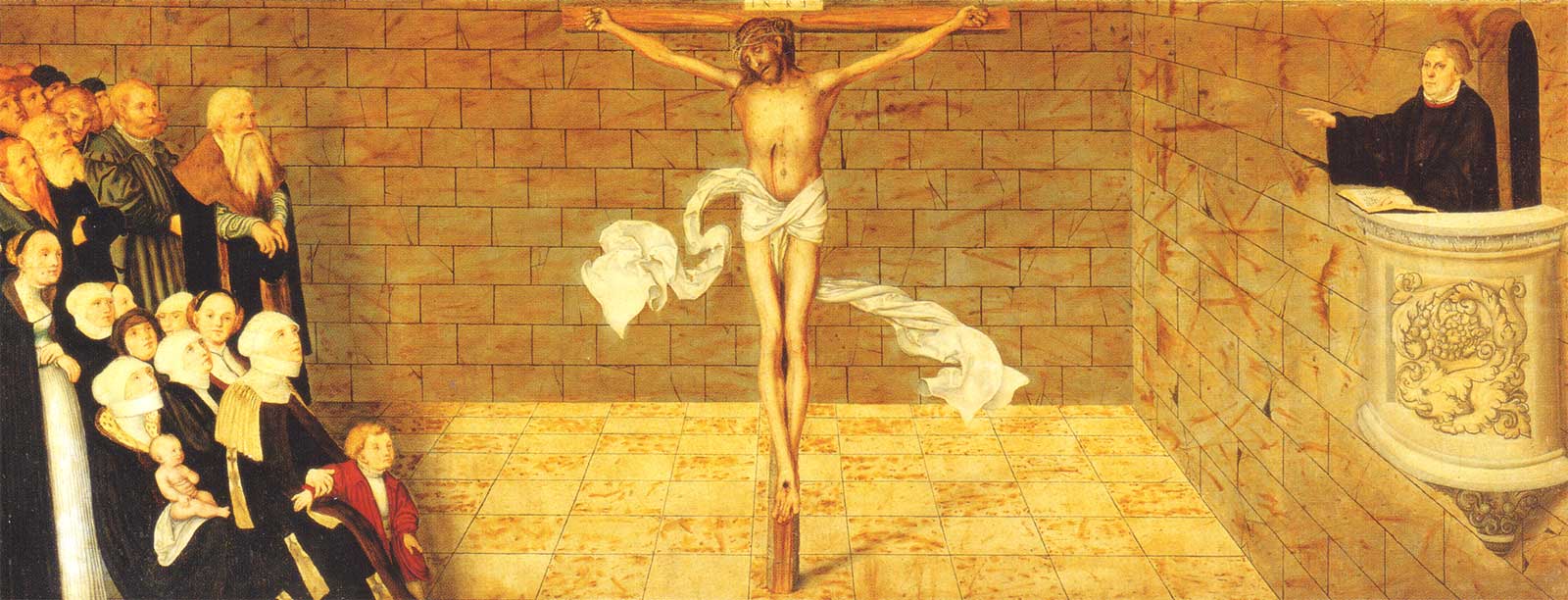
The picture below of Martin Luther preaching Christ (by Lucas Cranach) is one of my all-time favorites.  Notice what it communicates visually about preaching.  Luther has one hand on the Bible, reminding us that all preaching should be rooted in the Word of God.  The other hand is pointing to Christ and him crucified, the very heart of the redemptive message within the pages of holy Scripture.  And with the exception of one person looking toward us, everyone in the congregation has their attention focused on Christ as He is preached from the Bible.    

Luther Preaching Christ, Lucas Cranach, Wittenberg, St. Mary's Church, 1547
 Click here for a full resolution image of this painting.

Monday, January 7, 2013

Preachers, Don't Desecrate the Pulpit

Iain Murray, reflecting on the preaching ministry of Martyn Lloyd-Jones, offers this reminder (and warning) to all who preach:
The preacher's first and supreme concern has to be that his words are an expression of the mind of God in Scripture. "If any many speaks, let him speak as the oracles of God" (1 Pet. 4:11). The preacher is nothing unless he is an interpreter and exegete of revelation. Apart from that he has no right to command the attention of his fellow men. To expect the Holy Spirit to give his aid to what are merely our ideas is to desecrate the pulpit (italics mine).
--Iain Murray, Lloyd-Jones: Messenger of Grace
Preachers, read that last sentence again and meditate on it as you prepare for this Sunday!

Monday, October 8, 2012

A Sermon in Wood

We just completed a renovation of the sanctuary at our church in honor of our 175th Anniversary.  As a part of that renovation, we got a new pulpit (pictured above).  The following is an excerpt from the introduction of my first sermon in it, which I hope served as an appropriate dedication of the new pulpit and a fitting reminder of the fact that the pulpit matters because the Word of God preached from it matters.

Christians of the Greek Orthodox tradition have a wonderful saying about church architecture, which says, “A beautiful church is a sermon in stone.” In other words, the architecture of the church itself says something – the cruciform shape of the sanctuary, the vaulted ceilings and large columns that force your eyes upward to heaven and remind you of how small you are, the symbols of different aspects of the Christian faith used throughout. The artistry of the building is a sermon all by itself, a sermon in stone, as the Greek Orthodox say.

Well, when we as a church decided several months ago to renovate our sanctuary, I knew there wasn’t much need for me to weigh in on the decorative decisions because we had a great committee who was very capable of making those decisions. And haven’t they done a wonderful job! But I did want to have input on one thing. I wanted to have input on the new pulpit. And not for the reason you may think. It wasn’t just because I would be the one preaching from it. In fact, I hope our new pulpit is here long after I’m gone, so that’s not the main reason I wanted to have input on it. I wanted to have input on it because I wanted the pulpit itself to be symbolic of what we believe and value as a church. I wanted it to communicate something all by itself. I wanted our pulpit to be more than just a piece of furniture; I wanted it to be a sermon in wood. I wanted it to be a symbolic sermon all by itself.

So in a day and age in which many churches are moving away from even having pulpits, I wanted someone who walked into our sanctuary (even if it was empty and even if they knew nothing about us) to see our new pulpit and say to themselves, “This looks like a church that values the Word.” In a day and age in which pulpits seem to be getting smaller and smaller, I wanted us to have a pulpit that no one could miss…and I think we’ve succeeded! So if you’re wondering why our new pulpit is so large, the reason is because I wanted it to serve as a symbolic reminder to me and to anyone else who preaches in it of the weight and gravity and significance of the task of preaching. Puny pulpits too easily lend themselves to puny preaching. Lightweight pulpits are too susceptible to lightweight preaching that’s shallow and superficial. And we don’t want puny, lightweight, superficial preaching at First Baptist Church!

In a day and age in which biblical, expository preaching is lacking, I wanted us to have a pulpit that serves as an ever-present reminder that the regular, consistent preaching that should happen in our church is the preaching of the Word of God. That’s why “Preach the Word” is inscribed on the front of the new pulpit. And in a day and age in which the gospel is being distorted and even denied, I wanted us to have a pulpit placed right in the center of our sanctuary with a cross right on the middle of it, so that we remember that what is central here at First Baptist Church is the Word of God and what is central to the Word of God is Jesus Christ and him crucified and risen from the dead. So, that’s why there’s a cross right in the middle of our new pulpit.

Therefore, our new pulpit is more than just a piece of furniture. Our beautiful, new pulpit is a sermon in wood. But here’s the challenge that lies before us – will the sermons that flow from that pulpit match the sermon that is that pulpit? Will what comes out of it match what is on it? Will the actual sermons match the symbolic sermon? Because I’ve seen, and I’m sure you’ve seen, many a beautiful church building whose architecture preaches a wonderful symbolic sermon, but the actual sermons in those churches seem to speak of another God entirely. I’ve seen many a large, beautiful pulpit and yet what flows from those pulpits is a far cry from the Word of God.

So yes, the symbolism of our new pulpit is significant, and it matters. It says something, and it says something really important. But it’s not enough. Our new pulpit must be more than just a symbol. We need the actual sermons that flow from that pulpit to match the symbolic sermon that is that pulpit. We need sermons that recognize the weight and gravity and magnitude of being a messenger of the very words of God. We need sermons that point us to the cross of Calvary, that are centered on the gospel of Jesus Christ. And we need sermons that exposit the truth of Scripture, that preach the Word of God, that recognize that "man does not live by bread alone but by every word that comes from the mouth of God," that recognize that "faith comes by hearing and hearing through the word of Christ," and that recognize that "the grass withers and the flowers fall but the word of our God will stand forever."

Monday, July 9, 2012

Monday Morning Encouragement for Preachers

This is intended to encourage those of you who preached yesterday (and for those of you who listened to someone preach yesterday, here's some insight into how we preachers often feel...and how you can pray for us).
Few preachers who preach God's Word feel great when the sermon's done. I'm usually thinking about everything I didn't have time to say or even a few things I did say that I wish I hadn't.  Then the time for the benediction slips up on me, I give it, and then I sneak to the back door to talk with people as they walk out. Sometimes people come to talk, and I'm humbled and encouraged by the ways they say the Lord used the sermon in their lives. Other times no one says much of anything, which bothers me more than I wish it did.

But the immediate feedback - as much as we crave the instant gratification - isn't the point. A pastorate is made up of a lot of sermons, and the fact is, most of those sermons are going to be singles rather than triples or home runs. But that's fine. If the Lord is so kind as to give you even a long string of singles, that's purely of His grace, and your congregation will benefit and grow from that. You score runs with a string of singles. So don't worry if you haven't hit a home run in a while - and if you hit one today, don't get cocky! Either way, go home, rest, thank God for the grace He gave you to teach and encourage His people again, take some time off, and then start the whole process over the next week. Our God is a good God, and week after week, sermon after sermon, He will give grace and strength and insight to the men who preach His Word.

--Mark Dever and Greg Gilbert, Preach: Theology Meets Practice 

Monday, July 2, 2012

The Most Urgent Need of the Church

A great reminder from one of the greatest preachers of the last century and from one of my favorite books on preaching:
I would say without any hesitation that the most urgent need in the Christian Church today is true preaching; and as it is the greatest and most urgent need in the Church, it is obviously the greatest need of the world also.

--D. Martyn Lloyd-Jones, Preaching and Preachers

Tuesday, April 24, 2012

Robert Smith to Deliver Mullins Lectures at SBTS

For those of you in and around Louisville, I highly recommend going to hear Robert Smith deliver the Mullins Lectures at The Southern Baptist Theological Seminary this week.  And for those of you who cannot be there in person but would like to listen, you can get the livestream from the Southern website here

Dr. Smith will be giving three lectures, one each day (Tuesday-Thursday), and his overall theme is "Preaching as Intra-Trinitarian Presence."  The schedule and the topic of each day's lecture is as follows:

LECTURE I
God of Our Weary Years - Theocentricity 
Tuesday, April 24 (10:00am - EST)

LECTURE II
Theology of the HIMbook - Christocentricity  
Wednesday, April 25 (10:00am - EST)

LECTURE III
The Neglected God - Pneumacentricity 
Thursday, April 26 (10:00am - EST)

Few men have been more influential in my preaching than Robert Smith.  It was a privilege and a joy to sit under his teaching while at Beeson Divinity School and it is a pleasure to call him my friend.

By the way, his book, Doctrine That Dances: Bringing Doctrinal Preaching and Teaching to Life, is an excellent resource for those of you who preach and teach.

Thursday, January 19, 2012

The Dangers of Market-Sensitive Sermons

Douglas Webster on biblical preaching vs. market-sensitive preaching:
Biblical preaching is God-centered, sin-exposing, self-convicting and life-challenging - the direct opposite of today's light, informal sermons that Christianize self-help and entertain better than they convict.

There are so many illustrations in today's market-sensitive sermons that the hearer forgets the biblical truth that is being illustrated; so many personal anecdotes that the hearer knows the pastor better than she knows Christ; so many human-interest stories that listening to the sermon is easier than reading the Sunday paper; so practical that there is hardly anything to practice.

No wonder nominal Christians leave church feeling upbeat. Their self-esteem is safely intact. Their minds and hearts have been sparked and soothed with sound-bite theology, Christian maxims and a few practical pointers dealing with self-esteem, kids, or work. But the question remains: has the Word of God been effectively and faithfully proclaimed, penetrating comfort zones and the veneer of self-satisfaction with the truth of Jesus Christ?

--Douglas Webster, Selling Jesus: What's Wrong with Marketing the Church

Wednesday, November 3, 2010

Insipid, Innocuous Pablum

"How wearisome it must be to God to hear His inspired Word replaced by insipid, innocuous pablum dribbled out of pulpits!"

--John MacArthur, Ashamed of the Gospel

Tuesday, September 28, 2010

What Is Gospel Centered Expository Preaching?

Here is Jon Dennis' brief answer to that question:
Gospel centered expository preaching is uncovering the raw glory of God from a particular passage and showing how it relates to Christ.
--Jon Dennis, "Multiplying Men: Training and Deploying Gospel Ministers" in Preach the Word: Essays on Expository Preaching in Honor of R. Kent Hughes

Wednesday, September 1, 2010

Interview with Phillip Jensen (on preaching)

Below is a video interview with Phillip Jensen in which he discusses preaching, preachers, and listening to preaching (see Monday's post for his new book on preaching). It is just under 30 minutes, but it is worthwhile for preachers and hearers alike. So whether you spend your Lord's Days doing the preaching or listening to the preaching, you will benefit from Jensen's wisdom on this subject.

Phillip Jensen and Kel Richards - Preaching from Audio Advice on Vimeo.

Monday, August 30, 2010

Phillip Jensen Book on Preaching

Phillip Jensen - the Australian Anglican, mastermind behind Matthias Media, and wonderful example of a faithful preaching ministry - has a new book on preaching, The Archer and the Arrow: Preaching the Very Words of God.

Click here to read some of the blurbs for this new book.

Click here to read Tim Challies' overview of the book.

Monday, May 31, 2010

Diagnosing the Disease(s) of Contemporary Preaching

"Contemporary preaching suffers from a loss of confidence in the power of the Word...from an infatuation with technology...from an embarrassment before the biblical text...from an evacuation of biblical content...from a focus on felt needs...from an absence of the gospel..."

--Albert Mohler, from He Is Not Silent: Preaching in a Postmodern World

Tuesday, May 18, 2010

Russell Moore on "Preaching Like the Devil"

Russell Moore provides a good reputation for Baptists every time he writes for Touchstone (which readers of this blog will know is one of my favorite magazines/journals). His article in the May/June 2010 issue is no different. It is about preaching, but it deserves to be read not only by preachers, but also those who listen to preaching. It is titled "Preaching Like the Devil" (below is an excerpt).
The devil is a preacher. From the third chapter of the Bible onward, he is opening up God’s Word to people, seeking to interpret it, to apply it, to offer an invitation. So the old Serpent of Eden comes to the primeval woman not with a Black Mass and occult symbols, but with the Word she’d received from her God—with the snake’s peculiar spin on it. Throughout the rest of the canon he does the same, implicitly or explicitly.

Throughout the Old Testament, he preaches peace—just like the angels of Bethlehem do—except he does so when there is no peace. He points God’s people to the particulars of worship commanded by God—sacrifices and offerings and feast-days—just without the preeminent mandates of love, justice, and mercy. Satan even preaches to God—about the proper motives needed for godly discipleship on the part of God’s servants.

In the New Testament, the satanic deception leads the scribes, Pharisees, and Sadducees to pore endlessly over biblical texts, just missing the point of Christ Jesus therein. They come to conclusions that have partially biblical foundations—the devil’s messages are always expository; they just intentionally avoid Jesus.

So, the scoffers feel quite comfortable asking how a man from Nazareth could be the Messiah when the coming King is of Bethlehem. They find themselves wondering how the Son of Man can be crucified when the Bible says he lives forever. When Jesus says those who follow him should eat his flesh and drink his blood, there’s little doubt that the Adversary was there to point the crowds to Leviticus’s forbidding of the consumption of human blood. When the satanically inspired crowds crucified Jesus, they did so pointing to biblical texts that called for the execution of blasphemers and insurrectionists (Deut. 21).

When the early Church rockets out of the upper room in Jerusalem, Satan is there, with false teachers, to preach all kinds of things that seem to be straight from God’s Word—from libertinism to legalism to hyper-spirituality to carnality. He never stops preaching.
Read the whole thing here.

Thursday, April 29, 2010

Expository Listening

There are hundreds of books on preaching but not very many on listening to preaching. So when I come across one that looks helpful, I want to make others aware of it. Tim Challies has a brief review of Ken Ramey's new book, Expository Listening: A Handbook for Hearing and Doing God's Word, which looks to be one of those. You can read Challies' review here.

Other helpful resources for listening to sermons include Christopher Ash's booklet, Listen Up: A Practical Guide to Listening to Sermons and the first chapter ("A Healthy Church Member Is an Expositional Listener") in Thabiti Anyabwile's little book, What is a Healthy Church Member?. I highly recommend both of these.

Monday, April 19, 2010

Christopher Ash's The Priority of Preaching

Speaking of preaching, I was very pleased to see that one of the book give-aways at Together for the Gospel last week was Christopher Ash's book, The Priority of Preaching. You may remember a few previous posts I wrote back in the Fall on Christopher Ash's work - one here on the Priority of Preaching and one here on Listen Up: A Practical Guide to Listening to Sermons. Both of these are excellent resources.

Christopher Ash works with The Proclamation Trust and directs the Cornhill Training Course (a training course for preachers in the UK).

Simplicity in Preaching

The Banner of Truth has recently published in booklet form J.C. Ryle's address on Simplicity in Preaching. I highly recommend this little treatise - for preachers young and old alike. You will find an abundance of wisdom and common sense in these 22 pages. Here is a summary of the five points he discusses in the booklet:
  1. If you want to attain simplicity in preaching, you must have a clear knowledge of what you are going to preach.
  2. If you would attain simplicity in preaching, you must use simple words.
  3. If you would attain simplicity in preaching, you must seek to acquire a simple style of composition, with short sentences and as few colons and semicolons as possible.
  4. If you would attain simplicity in preaching, aim at directness.
  5. If you would attain simplicity in preaching, make abundant use of illustration and anecdote.

Tuesday, February 23, 2010

Two Things Every Preacher Must Have in His Proverbial Toolbox

Every preacher ought to utilize these two items:
  • A microscope - to analyze the details of the biblical passage being studied (i.e., for zooming in)
  • A telescope - to see how the biblical passage being studied fits into the larger context of the entire redemptive story of the Bible (i.e., for zooming out)

Monday, February 15, 2010

Noteworthy Quotes on Preaching

  • I never want to preach a sermon that would still be true if Jesus had not died on the cross. (Ed Stetzer)
  • Let a good expositional ministry be established and watch what happens. Forget what the experts say. Watch hungry people have their lives transformed as the living God speaks to them through the power of His Word. (Mark Dever)
  • Much of what emanates from modern pulpits would not be recognized by history’s great preachers as being Bible-based and glorifying to God. Rather than the spiritual meat the Body of Christ needs – marked by doctrinal clarity, a sense of gravity, convincing argument, and a proper focus on Christentire churches are being administered a sweet but substanceless snack by their pastors. Consequently, congregations leave the sanctuary malnourished and ill-prepared to stand firm when their faith is challenged. (Alistair Begg)
  • Throughout the history of the church the greatest preachers have been those who have recognized that they have no authority in themselves, and have seen their task as being to explain the words of Scripture and apply them clearly to the lives of their hearers. Their preaching has drawn its power not from the proclamation of their own Christian experiences or the experiences of others, nor from their own opinions, creative ideas, or rhetorical skills, but from God's powerful words. Essentially, they stood in the pulpit, pointed to the biblical text, and said in effect to the congregation, "This is what this verse means. Do you see that meaning here as well? Then you must believe it and obey it with all your heart, for God himself, your Creator and your Lord, is saying this to you today!" Only the written words of Scripture can give this kind of authority to preaching. (Wayne Grudem)
  • The gospel is preached in the ears of all men; it only comes with power to some. The power that is in the gospel does not lie in the eloquence of the preacher; otherwise men would be converters of souls. Nor does it lie in the preacher’s learning; otherwise it would consist of the wisdom of men. We might preach till our tongues rotted, till we should exhaust our lungs and die, but never a soul would be converted unless there were mysterious power going with it – the Holy Ghost changing the will of man. O Sirs! We might as well preach to stone walls as preach to humanity unless the Holy Ghost be with the Word, to give it power to convert the soul. (Charles Spurgeon)
HT: Ray Ortlund, Thabiti Anyabwile, and Colin Adams

Thursday, January 21, 2010

Grace-Soaked Truth and Truth-Filled Grace

Kevin DeYoung currently has a series of posts on his blog answering the question, "How Do You Put Your Sermon Together?" At the end of part 2, he says:
Mostly I pray for grace-soaked truth and truth-filled grace. And fresh unction from the Holy Spirit week after week.

That's an excellent way to pray for preachers (and to think about biblical preaching). If you're a preacher, pray that way for your own preparation and preaching. If you're not a preacher, pray that way for your pastor.

For DeYoung's full posts, see below: